
The Genetics of Obesity: Aetiology, Prevention and Therapy
The Obelisk project has emphasised that obesity is not simply a matter of personal responsibility or lifestyle choices. A person’s biological make-up profoundly shapes how they respond to food, hunger, and their environment.
Today, more than one billion people worldwide live with obesity, including 150 million children. Rising rates cannot be explained by individual choices alone. Instead, they reflect the complexity of obesity as a disease and the deeper biological, environmental, and societal factors that increase vulnerability in certain individuals.
Genetics plays a particularly significant role, with studies estimating that 40–75% of obesity risk is inherited, and rapid advances in genetic research are transforming our understanding of why obesity develops. A new article led by Obelisk partners, Amélie Bonnefond, Anita Morandi and Philippe Froguel, highlights how this science is now paving the way for more tailored and effective treatments.
Researchers have now identified more than 85 single-gene obesity disorders and over 1,000 genetic sites linked to body weight. These discoveries are marking the beginning of personalised obesity medicine, with the potential to improve obesity care.
What Did the Study Involve?
The study brought together a vast amount of genetic research to understand why some people develop obesity while others do not. Researchers analysed data from many large international studies, including genome-wide association studies (GWAS), whole exome and whole genome sequencing projects, and clinical trials involving people with rare genetic obesity conditions. By examining the DNA of hundreds of thousands - and, in some analyses, millions - of individuals, they were able to identify both rare single-gene causes of severe early-onset obesity and the many small genetic variations that contribute to common obesity.
The team also reviewed how these genetic differences interact with lifestyle and environmental factors, and how they influence treatment response. Together, these approaches allowed the researchers to map the full spectrum of genetic influences on obesity, from rare, powerful variants to the more subtle effects of hundreds of common genes. This comprehensive analysis also highlighted how these discoveries are paving the way for more personalised, biology-based treatments in the future.
Key Findings of the Study
Obesity has a strong genetic basis
Rare genetic mutations can cause severe early-onset obesity, while hundreds of common variants each add a small amount of risk. Obesity exists on a spectrum, not in simple categories.
Genetic discoveries are transforming treatment
Identifying specific genes has already led to targeted therapies for rare forms of obesity, showing how biological understanding can improve outcomes.
Genes and the environment interact
Lifestyle, social circumstances and environment modify genetic risk. Tools such as polygenic risk scores may help predict who is most at risk and who will respond best to different treatments.
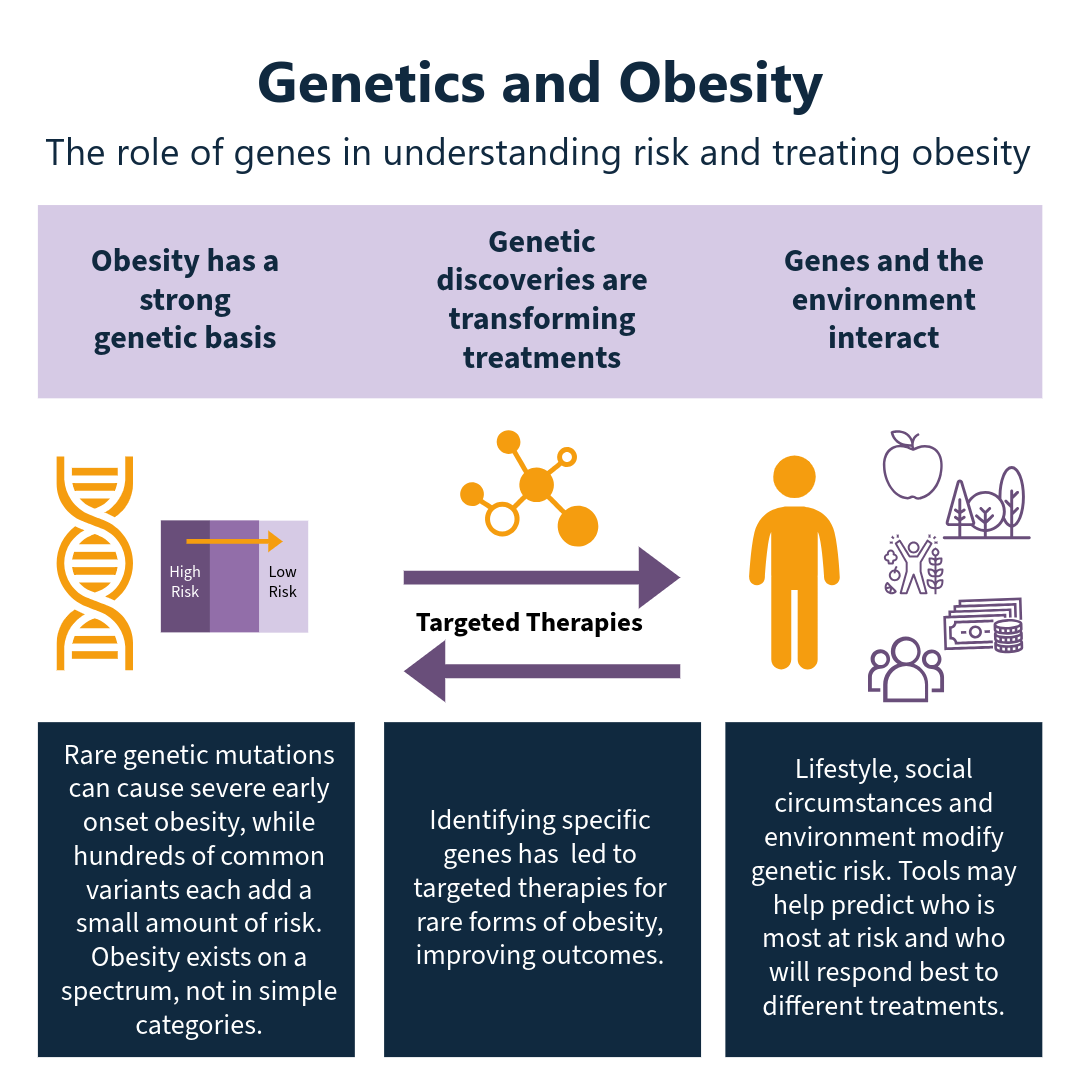
Genetics and Obesity
Obesity is a complex, multifactorial disease, influenced by both genes and the environment. Considering the roots of obesity is important.
While socioeconomic and environmental pressures, such as income, access to food and healthcare and how our towns and cities are built, play major roles in an individual’s obesity risk, the strong tendency for obesity to run in families shows how important genetics is in shaping that vulnerability.
Even so, having a genetic tendency does not mean obesity is inevitable. Factors such as age, lifestyle, and overall environment can affect how strongly our genes are expressed. For example, regular physical activity can reduce the effect of genes that predispose someone to a higher body weight. Likewise, what we eat and the social conditions we live in can increase or decrease genetic risk. All of this shows how obesity results from a complex mix of our biology and the world around us.
Thanks to modern genetic technologies, scientists can now see that many different genes are involved in obesity - from rare genetic changes that have a big impact, to very common tiny DNA differences that each have only a small effect on body weight. This creates a spectrum of obesity.
Types of Obesity
Researchers have identified many such genes by analysing large population datasets, looking for rare variants that appear more frequently in people with obesity. Some of these genes are involved in how the body processes food, regulates appetite, stores fat, or communicates hunger signals in the brain. Others affect metabolism, hormone regulation, or cellular processes linked to energy balance.
Importantly, some rare genetic variants that were once thought to have only mild effects on weight are now known to have much stronger impacts. In some cases, their influence is similar to that seen in single-gene forms of obesity. As a result, the line between monogenic, oligogenic, and polygenic obesity is often blurred. These discoveries reinforce the idea that genetic obesity is not a simple ‘on‑off switch’, but a spectrum in which different combinations of genes and environmental influences shape an individual’s risk.
This growing understanding helps explain why obesity looks so different from one person to another, and why personalised approaches to treatment may be more effective than one-size-fits-all strategies.
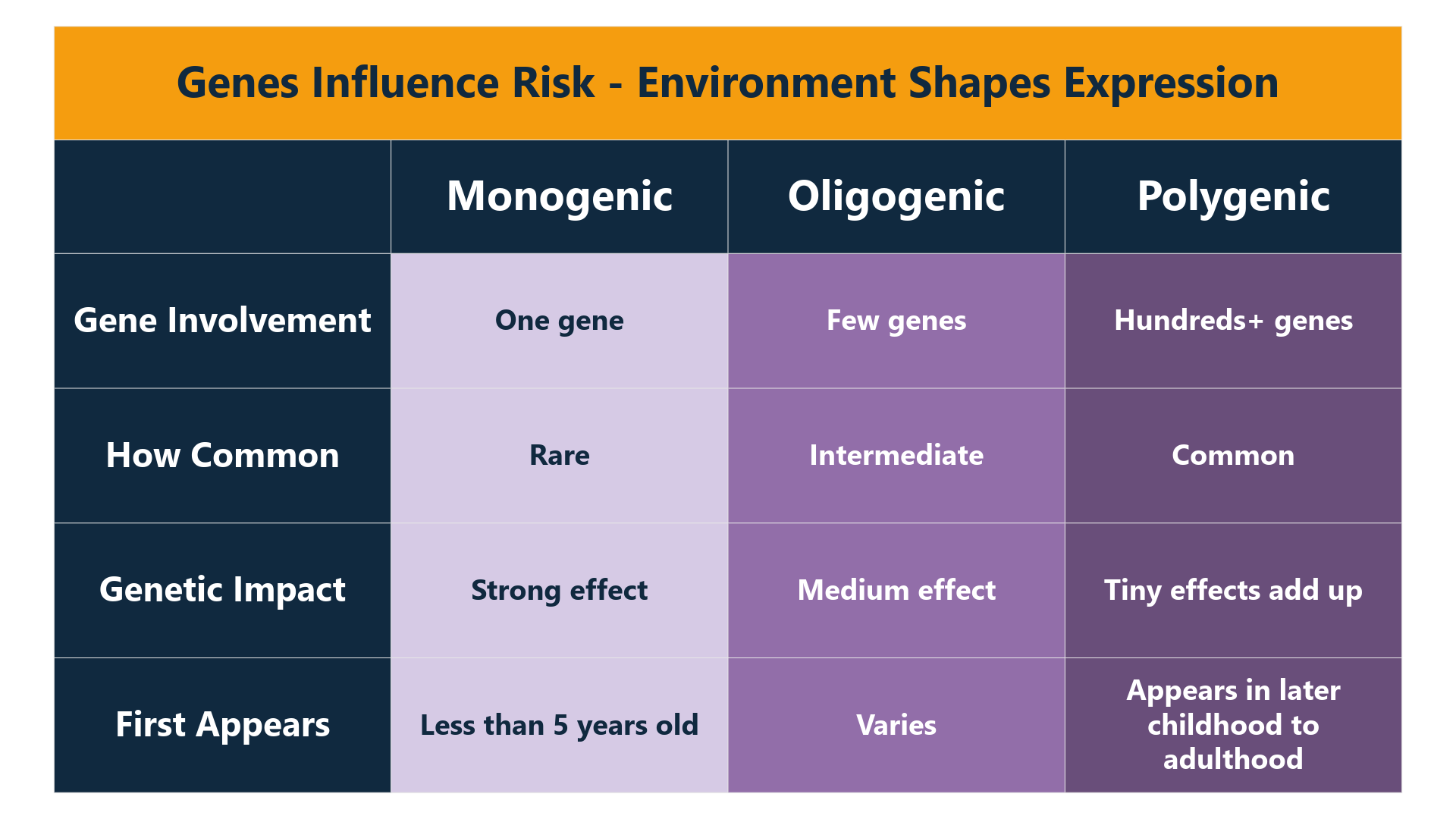
Modern genetic technologies reveal that obesity spans a continuum:
- Monogenic obesity: rare, caused by a change in a single gene with a strong effect
- Oligogenic obesity: caused by several rare variants that together increase risk
- Polygenic obesity: influenced by hundreds of common variants, each with small effects.
Monogenic Obesity
Monogenic obesity is a rare type of obesity caused by a change in one single gene that has a major impact on how the body regulates appetite and weight. Monogenic obesity almost always starts very early in life, typically before age five. Children affected often show rapid and severe weight gain, intense hunger (hyperphagia), and weight that does not improve despite usual lifestyle interventions.
How Single Gene (Monogenic) Obesity Happens
Scientists have now identified over 85 genes that can cause severe, early-onset obesity when they don’t work properly. These genetic changes can happen in several ways, for example:
• A tiny error in the DNA code that changes how a protein works
• A section of a chromosome being deleted
• Changes in how a gene is turned “on” or “off”
Some of these gene changes are inherited from parents, while others happen by chance. For several newly discovered genes, scientists still need more evidence to confirm their exact role in obesity.
Oligogenic Obesity
New genetic technologies that allow scientists to read large sections of our DNA or even our entire genome have recently helped identify genes linked to what is known as oligogenic obesity. This means that a person carries a small number of rare genetic changes that, on their own, are not enough to cause obesity outright. Instead, these genetic changes only increase the risk when combined with other factors, such as additional genes, lifestyle, environment, or other health conditions. In other words, oligogenic obesity sits in the middle ground: it is influenced by genetics, but not driven by a single gene alone, and it usually appears only when several risks come together.
Polygenic Obesity
At the far end of the scale is polygenic obesity, which involves hundreds to thousands of small genetic variations. GWAS have identified more than a thousand common single-nucleotide polymorphisms (SNPs) associated with BMI or obesity risk. These findings allow researchers to calculate polygenic risk scores, which summarise a person’s inherited predisposition to higher body weight.
Why Polygenic Risk Scores (PRS) Matter
PRS helps explain why:
• Some people gain weight easily even in similar environments
• Others remain at a stable weight despite living in an “obesogenic” environment
• Lifestyle changes work better for some people than others
PRS are an emerging tool that may help personalise the prevention and treatment of obesity. A PRS combines the small effects of many tiny genetic differences across a person’s DNA into one overall score. This score gives an estimate of how strongly someone is genetically predisposed to a particular trait, in this case, a higher body weight.
A large study1 involving 300,000 people showed how powerful this approach can be. Those with the highest genetic risk scores had an average BMI of 30 kg/m², while those with the lowest had an average BMI of 25.2 kg/m². People with high scores also had a greater risk of having related conditions such as heart disease and type 2 diabetes. Importantly, these genetic influences appear early in life and tend to become stronger with age. However, having a high PRS does not guarantee obesity, as 17% of people with very high scores remained in the normal weight category. On the other hand, almost no one with a low PRS went on to develop severe obesity during more than 30 years of follow up, suggesting that some people may be genetically protected.
Researchers are now developing PRS that work across different ancestries, and early studies show PRS may help predict:
• Who will respond best to lifestyle changes
• Who may benefit most from specific medications
• Who is at the lowest or highest long-term risk of developing obesity
PRS does not work in isolation; life circumstances matter. In a study2 of more than 3,000 children aged 2–16 years, the influence of genetic risk was significantly modified by factors such as parents’ education levels, how much dietary fibre children ate, and the amount of screen time they had.
Crucially, the environment modifies genetic risk through epigenetic changes, although this may become more difficult with a higher PRS. For example, compared with individuals at the 25th PRS percentile, those at the 50th percentile with a BMI of 28 kg/m² would need a mean daily step count of 16,190, an additional 6350 steps/day3, to achieve a similar risk reduction, which is likely an amount that is challenging to sustain in real life.
These findings highlight that public health recommendations not accounting for genetic background may underestimate the physical activity level required for effective obesity prevention in genetically at-risk individuals. Public health guidelines that assume equal biological starting points underestimate the needs of those with higher genetic vulnerability.
Together, these findings suggest that, in future, PRS and related genetic tools may help tailor obesity prevention and treatment more precisely. Although more research is needed, these approaches show real potential to predict who might benefit most from specific interventions, improving both prevention and treatment outcomes.
Key Recommendations from the Study
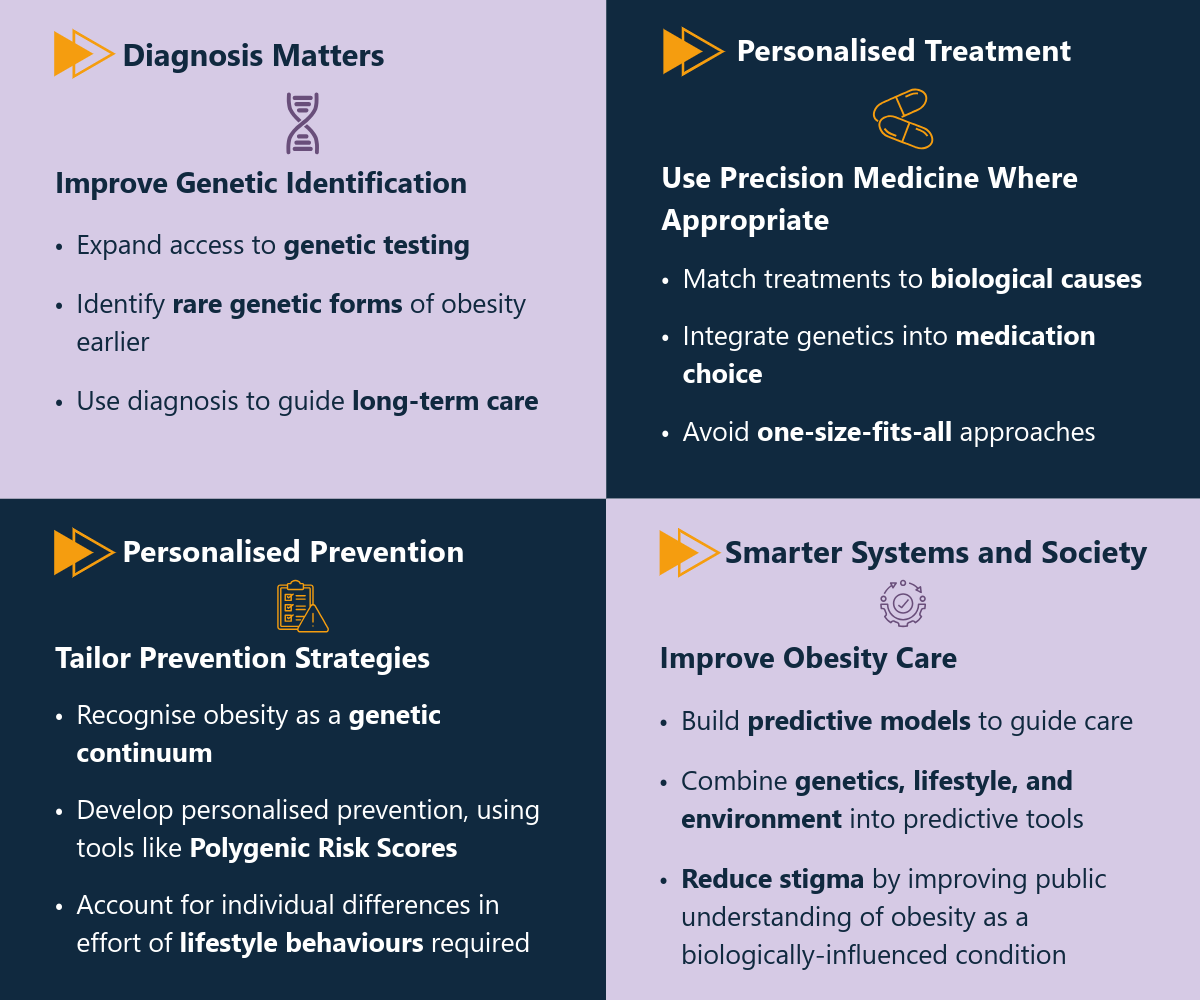
Looking Ahead: The Future of Personalised Obesity Care
General public health advice does not work the same for everyone. A “one-size-fits-all” approach may underestimate what is needed for those who are biologically more vulnerable. In the future, more sophisticated prediction models could help tailor obesity prevention and treatment to predict who is most at risk and who is likely to respond best to different interventions. These would combine many types of information, including:
- A person’s genetic risk
- Lifestyle and diet
- Social and environmental factors
- Possibly information from the gut microbiome
These developments point towards a future where obesity care is more personalised, more effective, and better aligned with each person’s unique biology and circumstances.
Paper
Bonnefond, A., Bruner, W.S., Grant, S.F.A. et al. The genetics of obesity: aetiology, prevention and therapy. Nat Metab (2026).
References
- Khera, A. V. et al. Polygenic Prediction of Weight and Obesity Trajectories from Birth to Adulthood. Cell 177, 587-596.e9 (2019).
- Hüls, A. et al. Polygenic risk for obesity and its interaction with lifestyle and sociodemographic factors in European children and adolescents. Int J Obes (Lond) 45, 1321–1330 (2021).
- Brittain, E. L. et al. Physical Activity and Incident Obesity Across the Spectrum of Genetic Risk for Obesity. JAMA Netw Open 7, e243821 (2024).
Glossary Terms
Base
One of the four building blocks - or chemical ‘letters’- that make up the genetic code in DNA: adenine (A), thymine (T]) cytosine (C), and guanine (G). If DNA is an instruction manual for your body, bases are like the letters that are used to write it. Each base is a component of a nucleotide.
Genome
The complete set of genetic instructions (DNA) found in an organism’s cell, containing all the information needed for growth, development, and normal functioning.
Nucleotide
The fundamental building block of DNA, responsible for storing and transmitting genetic information. Individual nucleotides join to form long chains. Each nucleotide consists of a base, a sugar molecule, and a phosphate group; when linked, these components form the backbone of the DNA “ladder.” The sequence of nucleotides determines genetic instructions.
Single-nucleotide polymorphisms (SNP pronounced ‘snip’)
A variation at a single nucleotide position in the DNA sequence, where one base is substituted for another within a nucleotide, that occurs in at least one per cent of the population.
