28th September 2026
Regulation, affordability and political will: what it takes to tackle childhood obesity in Europe
Insights from the Third Obelisk Policy Workshop
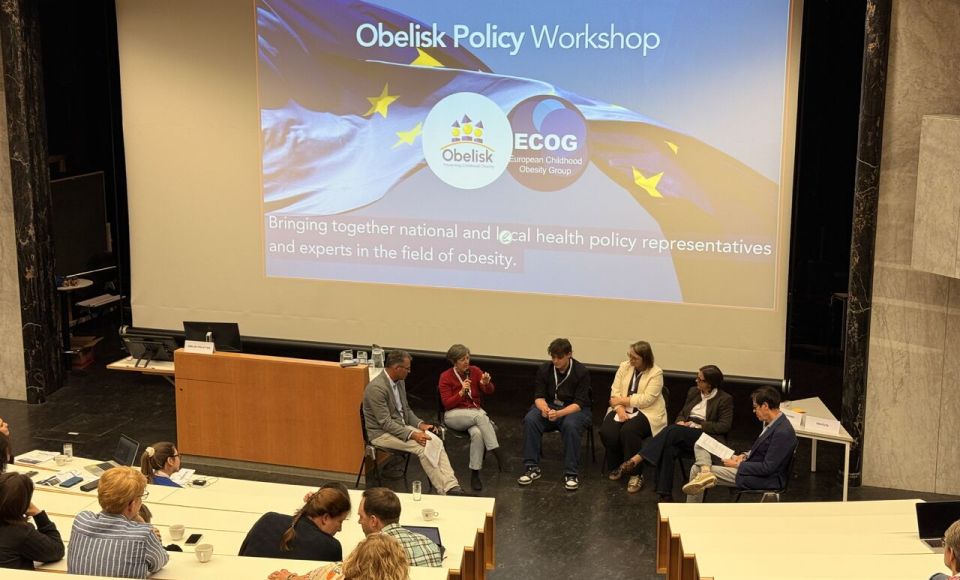
On 18th September 2026, Obelisk held its third policy workshop, hosted by our partner, the European Childhood Obesity Group (ECOG), during their 35th annual congress in Salzburg, Austria. This year's edition looked at how Europe, with a focus on German-speaking countries, is responding to childhood obesity from a public health perspective, and how EU projects can contribute to these efforts.
Moderated by Philippe Froguel, Professor and Chair of Genomic Medicine at Imperial College London, Professor of Endocrinology at Lille University Hospital, and Co-Coordinator of the Obelisk Project, and by Daniel Weghuber, ECOG Past President and Professor of Paediatrics at Paracelsus Medical School (PMU) in Salzburg, the roundtable brought together voices from government, academia, clinical practice, and patient advocacy. Panellists included:
- Judith Benedics, Head of the Unit at the Austrian Federal Ministry of Social Affairs, Health, Care and Consumer Protection.
- Amandine Garde, Professor of Law at the University of Liverpool, expert in consumer protection and public health.
- Bianca Itariu, Endocrinologist and Board Member of the Austrian Obesity Society.
- Philipp Pontasch, a young Austrian Patient Representative sharing his own experience with weight loss.
Encouraged by the two moderators, and through three rounds of questions, the panellists shared their ideas, expertise, and suggestions. Three key takeaways emerged from the panel:
1. Healthy choices cannot depend on individual willpower alone; the environment must change. Speakers agreed that the choices children and families make are shaped by the environments surrounding them. For instance, supermarket sweets and unhealthy food are placed at eye level at the checkouts, and aggressive marketing, mostly on social media, makes healthy habits harder to keep. Moreover, the speakers stressed that access to schools serving healthy food and opportunities for physical activity should not be reserved for wealthier neighbourhoods only. Panellists called for strong, government-led regulation to make this a reality, highlighting three main priorities: restrictions on the marketing of unhealthy food, implementation of measures such as Nutri-Score, and legal standards for schools and kindergartens, which shape children's diet and habits from an early age. They agreed that environments can be changed, but it is not that easy, as it is mostly a question of political will.
2. Childhood obesity is also a socioeconomic issue: healthy food must be affordable and accessible to all. A recurring point during the discussion, including from the audience, was that price remains one of the main determinants, together with marketing, of what families eat, and that healthy food is out of reach for many. For instance, taxation of unhealthy foods in some countries helped adjust consumption. Asked about how to tackle the issue at its root, speakers stressed that prices, school policies and healthy food guidelines are fundamental, while acknowledging the strong opposition health policies often face. They also cautioned that legislation is not a panacea and does not replace treatment: children and families from lower-income backgrounds need access to care as well as healthier environments.
3. Political will, cross-sector coordination, and integrated care are essential, with young people “at the table”. Obesity is too widespread to be handled in isolation; panellists argued, calling for a coordinated approach, even suggesting an obesity ministry, and obesity care to be fully integrated into the health system. Austria's multisectoral national nutrition strategy was cited as an example of raising awareness across different sectors. Speakers agreed that political will is the decisive factor, and that action is needed across sectors, not only in health. Asked how EU projects like Obelisk can work hand in hand with national ministries and administrations, panellists highlighted the value of EU-funded research, including transparent data, and the strong political will to act. They also urged policymakers to involve young people in the discussion: their voices are hard to dismiss, and change in food environments has been largely driven by the younger generation.
The roundtable stressed the need to move from individual responsibility to structural, evidence-based, and legally grounded action. As one panellist put it, small changes can eventually lead to big ones. The session closed with a strong reminder that children's health should never be sacrificed for the sake of economic growth.
The discussion builds on previous editions of the Obelisk Policy Workshop, held in Ghent during the 33rd ECOG congress and in Uppsala during the 34th. ECOG and the Obelisk Project remain committed to continuing this dialogue and advocating policies that put children's health first. The fourth edition of the Policy Workshop will be organised during the 36th ECOG Congress in Athens.
