
Growing Up in a Health-Constraining Environment: What Drives Childhood Obesity and How We Can Prevent It?
It has been well documented that childhood obesity is a growing global concern, and many factors are contributing to this rise. One area that has been increasingly researched is the link between obesity and our environment. In this article, we explore the elements that can create a health-constraining environment, how to move towards a health-promoting environment, and why this is important for childhood obesity prevention.
What is a Health-Constraining Environment?
The term obesogenic environment was first used in the 1990’s as a hypothesis to try to explain changes in obesity rates. Earlier descriptions expressed the environment in terms of ‘micro-environments’ such as home, schools and neighbourhoods, being influenced by ‘macro environments’, for example, education, healthcare, government policy and social beliefs and culture1.
There is growing evidence on the interaction between the urban physical and social environment and the biology of obesity. Obesity is understood to result from a complex interplay between a child’s environment and their biological and behavioural responses to that environment. These responses can vary between individuals and are strongly influenced by genetics and life-course factors.
Although the term “obesogenic environment” is widely used in public health, it is important to recognise that it is not a perfect or neutral phrase. For some people living with obesity, describing communities, families or daily routines as “obesogenic” may feel stigmatising, as though larger bodies are being used as evidence of a “defective” environment. This is particularly important because obesity is often misunderstood as simply a matter of body size or personal behaviour, rather than a complex, chronic disease that may impair health and is shaped by genetics, neurobiology, endocrine regulation, medications, stress, stigma, early-life experiences and wider environmental factors.2
While the term was originally intended to shift attention away from individual blame and towards the systems that shape health behaviours, it can still oversimplify the causes of obesity if used without context. Therefore, in this article, the term health-constraining environments will be used instead to describe environments that can make health-promoting behaviours harder to access, afford or sustain-particularly for children and families already facing social and economic disadvantage.
Key Characteristics of a Health-Constraining Environment
Policy and interventions related to obesity have tended to focus on individual dietary and wellness advice, but this is likely to be ineffective if someone is living in an environment that makes unhealthy behaviours the easier or even the only option. Focusing on creating health-promoting environments may be a more effective way to evoke change at a societal level.
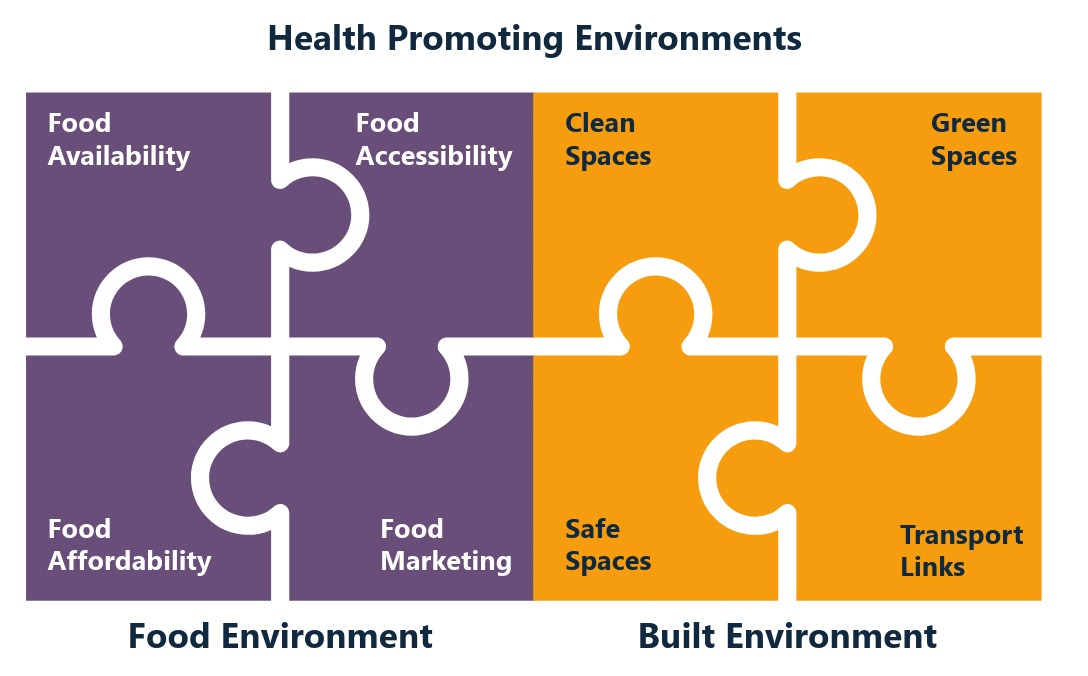
What are the areas that make up a Health-Constraining Environment?
Food Environment
The food environment incorporates the features of our neighbourhood and how these interact with our personal circumstances in relation to our food choices. This is shaped by four factors: availability, accessibility, affordability, and advertising. When we explore these, we start to understand why children from low-income households, and those living in deprived areas, are disproportionately affected by obesity3 as their food environment makes healthy eating more challenging.
Food Availability
Availability means the physical presence of foods within environments children interact with and this is particularly influential in children as they are more reliant on adults and institutions and often have less autonomy in their food choices.
Home Food Environment
The availability of foods in the home environment is known to shape a child’s food choices and long-term eating habits.
The home food environment represents a key micro-level component of the child’s environment, shaping their dietary exposure while reflecting broader structural and commercial food system influences.
Readily available fruits and vegetables or energy-dense food or drinks can increase intake in either direction. Therefore, parental purchasing patterns and household norms for meals, snacking and portion sizes will all influence a child’s food environment and therefore choices. However, homes do not exist independently of structural food systems, so the home food environment will be influenced by many of the factors we discuss below.
School Food Environment
Children spend about a fifth of their week in school, making it a critical setting for shaping lifelong dietary habits and reducing health and nutrition inequities. Yet, according to the World Health Organisation4, foods served, sold or promoted in and around many schools often include products high in saturated fats, free sugars and salt, and are not aligned with national dietary guidance.
The availability of foods that children are offered, sold and exposed to across the school day (meals, snacks, drinking water, vending/shops, fundraising, celebrations and in‑school marketing) is one of the most influential settings within their wider environment.
The food and drink norms set here shape daily energy intake, taste preferences and social expectations around eating and activity, with effects that track into adolescence. Importantly, improving school food is also an equity lever: universal standards and provision can lift diet quality for all pupils while narrowing gaps for children in more disadvantaged areas.
Food Accessibility
Having fresh foods accessible to all to easily buy and consume is obviously of great importance to encouraging health-promoting behaviours.
In a health-constraining environment, there is often a lack of fresh produce accessible to its local residents, a term often referred to as food deserts. Food deserts are neighbourhoods where poverty, poor public transport and shortage of large supermarkets severely limit access to affordable fresh foods such as fruit and vegetables. One UK study defined a food desert as neighbourhoods of between 5,000 and 15,000 people served by two or fewer big supermarkets. In “normal” areas of this size, there are typically between three and seven large food stores5, although there is no universal definition.
This can be exacerbated by an area also having a high density of fast-food outlets known as ‘food swamps’, which again are mostly found in deprived areas, further adding to inequality in access to nutritious foods.
In these areas, where food choice is more limited than elsewhere, it may be particularly hard for households to buy healthy food conveniently, at a reasonable price, especially for those further disadvantaged, for example, through disability.

Food Affordability
No matter how hard we work to make fresh, healthy foods accessible, the problem will remain unless people can afford to buy them. Having said that, increasing availability could reduce the risk of people paying a ‘poverty premium’ on any available fresh foods (higher unit prices in local convenience stores), which can add further burden to those in a health-constraining environment.
Meeting dietary guidelines can come at a cost. Across Europe, the cost of a healthy diet, measured in purchasing‑power terms to reflect price differences, remains substantial. For low‑income households, food shopping absorbs a far larger share of disposable income than for higher-income households. The World Bank classifies a healthy diet as ‘unaffordable’ when its cost is more than 52% of a household income7. When the cost of a healthy basket exceeds the food budget available after essential bills, families are pushed toward practical trade-offs such as choosing cheaper, energy‑dense options even when healthy outlets are nearby.
In 2024, 8.5% of the EU population were unable to afford a meal containing meat, fish or a vegetarian equivalent every second day. The percentage was significantly higher for people at risk of poverty, at 19.4%, than for people not at risk of poverty (6.4%)6.
Advertising
Food marketing has been identified as a primary influence on diets, affecting children’s nutrition knowledge, preferences and consumption patterns.
Marketing of foods is everywhere; however, the number of foods high in fats, salts and sugars (HFSS) is disproportionately represented. In the UK alone the top HFSS brands have a budget of over £143 million advertising their products each year – yet just 1.2% of food and drink advertising promotes fruit and vegetables8, and this is a similar picture when you look around the globe, for example. In one Canadian study9, over 90 per cent of food and beverage product adverts viewed by children and teens online were for unhealthy products, and 52% of food advertising seen on television in France is for HFSS products10. This is in stark contrast to the public health guidance on food and drink, which tells us these foods should be occasional, demonstrating that current marketing is communicating contradictory messages for children.
Marketing has become sophisticated, and there are multiple channels where children can be reached, such as TV, social media, gaming and outdoor marketing. The World Health Organization states that there is clear evidence that childhood obesity is influenced by less healthful foods being marketed to children and has created guidelines to reduce exposure11.
We are starting to see countries legislate to protect children from the harms of HFSS food marketing. Most recently, the UK Government banned adverts for less healthy foods and drinks on television before 9 pm and online at all times12. Although this move is welcomed, there has been criticism it doesn’t go far enough13 and that food companies are shifting to other forms of advertising to get around these restrictions, with outdoor advertising increasing in recent years since the announcement of the ban14. Therefore, future policy should consider all forms of marketing to ensure we are truly protecting children.
Built Environment
The built environment refers to all human-made surroundings and infrastructure that provide the setting for daily human activity, i.e. the physical structures and spaces where children live, learn, eat, sleep, and play. This can range from homes, schools and parks to roads and utility networks, leisure amenities and pollution. In recent years, public health research has expanded the definition of the built environment to include healthy food access, community gardens, walkability, and bikeability.
Features of the built environment can significantly influence children’s physical activity levels, diet, sleep, and stress - factors that collectively impact their risk for obesity15.
Attention has been drawn to aspects of the built environment that can be adapted to result in improved lifestyle and positive health outcomes. Those living in areas without access to safe green spaces and pathways to walk or cycle will likely have increased sedentary behaviour such as higher screen time and more use of cars to get around.
A range of studies have explored the relationship between access to nature and childhood obesity. A systematic review found access to green spaces was positively associated with physical activity and negatively associated with television watching time, body mass index and weight status amongst children16. Better access to green space was significantly linked to a lower risk of overweight/obesity. Traditionally, individuals were blamed for allowing children to be overly sedentary, but increasingly we are understanding that the environmental factors must be conducive for being physically active. Having safe walking routes is important to children, particularly adolescents, who can benefit hugely from having increased independence to access their local area by walking or cycling.
Parks, sports fields and green spaces offer more to children than just areas to perform physical activity- they are areas to play, socialise and support emotional and cognitive development. They offer opportunities for children to get together and partake in physical activity, which can reduce the need to rely on screen-based activities at home. Therefore, the higher risk of obesity for children without access to these spaces is not only linked to increased sedentary time, but also to a wider set of interconnected factors that shape daily routines, diet, and opportunities to be active that make healthy choices harder to sustain.
Other factors from the built environment that may impact childhood obesity are:
- Inequality: There are neighbourhood disparities in access to green spaces and safe places to play, and this contributes to unequal health outcomes. Low-income households and communities of colour are more likely to lack the resources that are required to lead a healthy, active lifestyle15.
- Noise and air pollution: Noise may impact children’s physical and mental health, cognitive development, sleep and physical activity levels. Lower physical activity behaviours, including active transport in areas with high noise pollution has been documented. Although the association between noise pollution and childhood obesity is inconclusive as it stands, it is an area worth further consideration as there is evidence in adult cohorts that has found road traffic noise is significantly related to obesity16. Several studies have suggested that exposure to air pollution appears to be linked to childhood obesity. For example, a study of children and adolescents who moved to more polluted areas, compared to the same or less polluted areas, had higher age- and sex- adjusted body-mass index in the six months following moving, adjusting for factors including neighbourhood socioeconomic conditions17.
- Crime: Increased crime or lower perceived safety in an area can lead to reduced outdoor physical activity and increased stress16, both of which are risk factors for obesity, although the evidence on crime and obesity is currently inconclusive.
Therefore, the higher risk of obesity among children without access to these spaces is linked not only to increased sedentary time but also to a broader set of interconnected factors that shape daily routines, diet, and opportunities to be active, making healthy choices harder to sustain.
Policy and Public Health
Moving forward, policies to ensure the careful planning of urban areas can prevent overcrowding and provide adequate access to leisure facilities and spaces that promote physical activity, reduce stress, and encourage social interactions. System-wide actions, including collaboration between public health and urban planning, are needed to create equitable built environments for all.
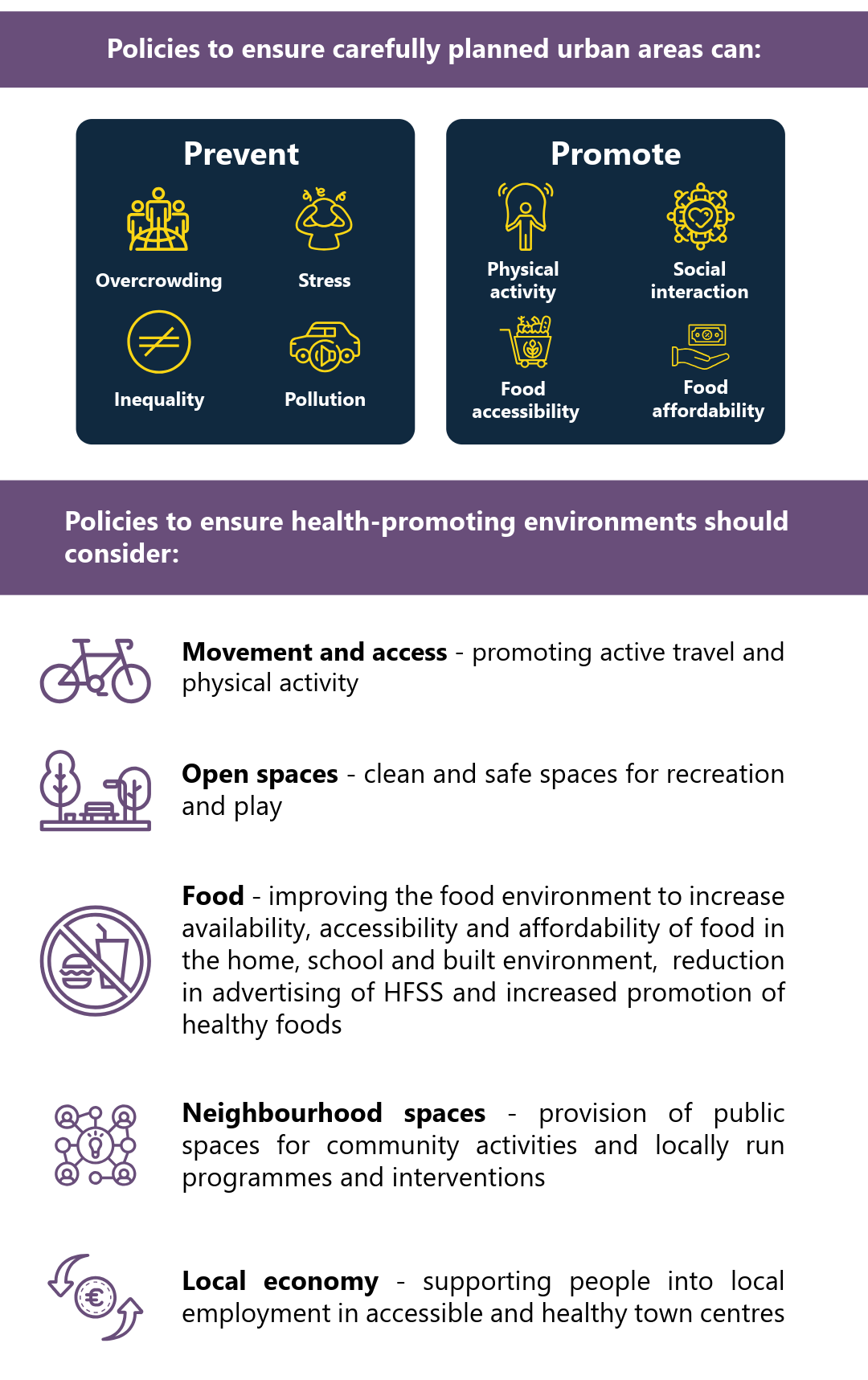
In summary, the roots of childhood obesity are complex, and risk is shaped by environments as much as by individual factors. Children's daily surroundings - at home, school, online and in their neighbourhoods - nudge eating and movement in healthier or less healthy directions. Those nudges are shaped by the physical (what’s available), economic (what it costs), political (the rules), and sociocultural (our norms) sides of everyday life.
Recognising this complexity helps move the focus of obesity from personal responsibility to system-led when designing environments that make healthy choices easy, affordable and appealing.
Prevention, therefore, means changing the settings where children spend time. If Europe aligns marketing restrictions, school and public food standards, pricing and urban design, then healthier choices become the norm for all children, not just those with the most resources.
Further Reading
LongITools Policy Briefing. Understanding the Exposome: Priorities for Policy and Practice. June 2025
References
1Egger, G., Swinburn, B., & Rossner, S. (2003). Dusting off the epidemiological triad: could it work with obesity? Obesity Reviews, 4(2), 115-119.
2World Health Organization (2025) Obesity and Overweight. [Accessed online 21.07.26]
3World Health Organization (2024) The inequality epidemic: low-income teens face higher risks of obesity, inactivity and poor diet. [Accessed online 13.01.2026]
4World Health Organization. (2025). Policies and interventions to create healthy school food environments: WHO guideline. In Policies and interventions to create healthy school food environments: WHO guideline.
5Corfe, S. J. S. M. F. (2018). What are the barriers to eating healthily in the UK. The Social Market Foundation.
6Eurostat (2025) Almost 9% in the EU could not afford a proper meal. [Accessed online 10.02.2026]
7Csákvári, T., Egyed, J., Elmer, D., Kajos, L., Kovács, B., Pónusz-Kovács, D., & Boncz, I. (2024). RWD45 Inequalities in the Costs and Affordability of a Healthy Diet in Europe between 2017 and 2021. Value in Health, 27(6), S365.
8Taking down junk food ads, how local areas are taking action on outside advertising (2019). A Sustain and Food Active publication [Accessed online 10.02.2026]
9Potvin-Kent M: The Kids are Not Alright: how the food and beverage industry is marketing our children and youth to death (2017).
10Escalon, H., Courbet, D., Julia, C., Srour, B., Hercberg, S., & Serry, A. J. (2021). Exposure of French children and adolescents to advertising for foods high in fat, sugar or salt. Nutrients, 13(11), 3741.
11(2016). Tackling food marketing to children in a digital world: transdisciplinary perspectives. Copenhagen: WHO Regional Office for Europe.
12Department of Health and Social Care, Dalton, A (MP) (2026). Landmark junk food ad ban to protect kids’ health. [Accessed Online 23.2.26]
13Nesta (2026) Nesta Responds to new regulations restricting advertising of less healthy food or drink. [Accessed online 23.02.26]
14The Food Foundation (2025) Regulations failing as report shows food industry finds new ways to advertise unhealthy food to young people. [Accessed online 23.02.26]
15Galvez, M. P., McCarthy, K., Sarabu, C., & Mears, A. (2024). The built environment and childhood obesity. Pediatric Clinics of North America, 71(5), 831.
16Jia, P., Cao, X., Yang, H., Dai, S., He, P., Huang, G., ... & Wang, Y. (2021). Green space access in the neighbourhood and childhood obesity. Obesity Reviews, 22, e13100.
17Warkentin S, de Bont J, Abellan A, et al. Changes in air pollution exposure after residential relocation and body mass index in children and adolescents: A natural experiment study. Environ Pollut. 2023;334:122217. doi: 10.1016/j.envpol.2023.122217
