9th June 2026
Obelisk Annual Consortium Meeting in Paris
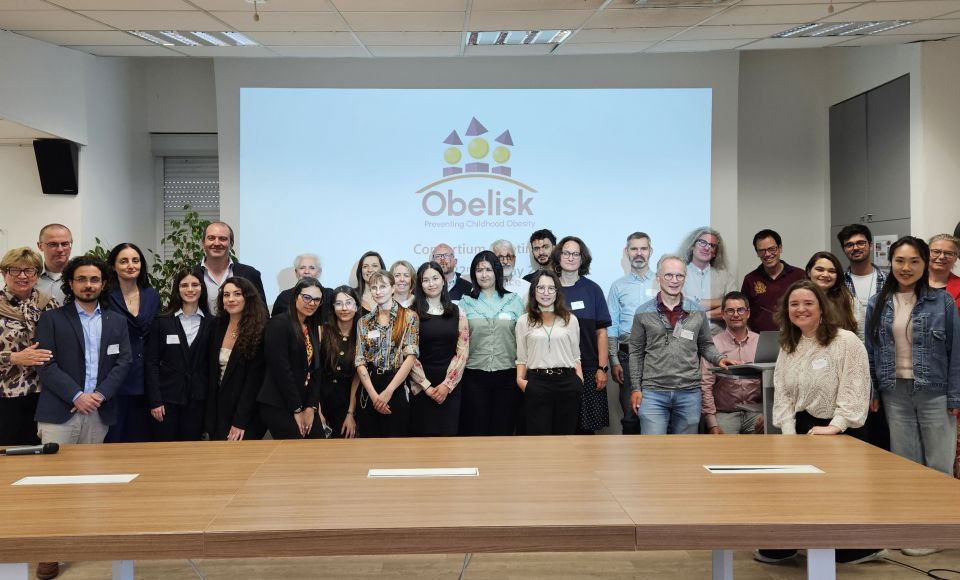
The annual Obelisk consortium meeting took place on the 21st-22nd May 2026 at the Institute Cochin in Paris.
It was a successful event that brought together our 16 partners from universities, research institutions, and small and medium-sized enterprises across nine European countries.
During the meeting, partners shared work package updates on their progress in year three of this five-year project. Results were presented from various studies, with the genetics and epigenetics of obesity emerging as a core theme discussed by several researchers.
The concept of obesity existing on a spectrum - from monogenic to oligogenic to polygenic - was introduced by our project co-lead following her research into the genetics of obesity. There were also important discussions around the ethical, legal, and social implications of conducting research in childhood obesity, and how these considerations, alongside wider psychosocial factors, should inform policy recommendations.
Collaboration and Communication
A central theme throughout the meeting was the recognition that obesity is a complex condition, shaped by multiple biological, social and environmental influences. Addressing this complexity requires joined-up thinking, and the consortium highlighted how collaborative working enables us to connect insights across disciplines.
Discussions emphasised that the impact of our work is maximised when we continue to share knowledge, align ideas, and build on each other’s expertise. The consortium strengthened this collective resolve, recognising that by piecing together diverse perspectives, we are better equipped to understand the bigger picture and drive meaningful change.
The discussions also highlighted the importance of embedding ethical, legal and social implications (ELSI) into research design. This shared commitment ensures that our work is not only scientifically robust but also responsible and supportive of the populations it seeks to benefit.
Finally, there was strong alignment around the need to translate research findings into meaningful policy. By working collaboratively, the consortium is well-positioned to ensure that insights from childhood obesity research inform approaches that address broader psychosocial factors, while maintaining continued attention to ethical and societal considerations.
Data Sharing
One of the project’s key published outputs is the data catalogue. The team from the Swiss Institute of Bioinformatics (SIB) presented an overview of this resource and provided a progress update. The data catalogue enables sharing of metadata from seven European cohorts within the Obelisk project, supporting FAIR (Findable, Accessible, Interoperable, Reusable) data access for other researchers. This is a clear example of how the project is actively promoting collaboration, both internally and with other EU networks, to maximise the value of available data within the field.
Summary
Overall, the consortium highlighted the significant progress made to date and reinforced the importance of collaboration, communication, and data sharing in addressing the complex challenge of childhood obesity. By continuing to work collectively and harnessing shared expertise and resources, the project can deliver impactful research and meaningful policy contributions in the years ahead.
